
5 Takeaways from Celtics Win Vs. Thunder
And it was a BIG TIME win

Was that the best Celtics game of the season? It’s got to be up there!
Boston withstood whatever the Oklahoma City Thunder threw its way and consistently created avenues to exploit. Of course, it helped that Jayson Tatum had his best game since returning from injury, and that Jaylen Brown clicked into gear.
Let’s dive into 5 takeaways from last night’s game.
1. Jaylen Brown clamped SGA
Shai Gilgeous-Alexander ended the night with 33 points on a ridiculous 83.3% shooting. The MVP-favorite doesn’t force his shooting opportunities very often, and when he does, they still find ways to go in.
Yet, of those 33 points SGA dropped last night, none of them came when he was being guarded by Jaylen Brown.
0.
Zilch.
Nada.
According to the NBA’s matchup data, Brown spent the most time guarding SGA out of any Celtic, with 4:35. During that time, SGA took no shots, drew no fouls, and only generated 2 assists.
The Thunder still managed 25 points as a team, but with Brown doing his thing, SGA was effectively nullified.
Oklahoma had to find ways of forcing switches to free up SGA. At which point, SGA is somebody else’s problem — and that’s a tough problem to inherit.
Nevertheless, Brown deserves all the praise possible. He’s been vocal about being one of the best two-way players in the world. Last night, he stepped up to the plate against a premier scoring talent in the league and kept him contained.
SGA is always going to get his. That’s a cold, hard fact. But, for almost five minutes of the game, Brown took the challenge, rose to the occasion, and blunted the Thunder’s most dangerous player.
Oh, and Brown ended the night with 32 points, 8 assists, 8 rebounds and 2 steals. I don’t know about you, but to me, that sounds like he won this iteration of the battle between MVP candidates.
*Side note — this doesn’t mean SGA didn’t score in possessions where he was originally guarded by Brown. It means that when Brown was the primary on-ball defender, SGA didn’t even attempt a shot. He might have done so when/if a switch occurred. Still, Brown held one of the MVP front-runners to 0-for-0 shooting in almost 5 minutes; that’s crazy impressive. At least, it is to me.*
2. Jayson Tatum’s Decision Making
A lot has been said about Tatum’s shooting struggles over the past week or so. Honestly, I think any criticism of Tatum’s shot-making is far too early, as he’s still dusting off the rust and building back up to full fitness.
I spoke about this yesterday in an episode of the Celtics Chronicle podcast.
There’s plenty of time to dissect Tatum’s shooting splits, shot selection and the incremental improvements we hope to see in the coming weeks.
However, today I want to focus on his decision-making, passing, and processing speed.
I thought those aspects of his game looked significantly sharper last night.
This play was the first instance of Tatum’s processing speed and passing ability getting closer to the level we’ve become used to. Boston runs a simple Zoom action to get Tatum the rock at the top of the perimeter.
Oklahoma is looking to blow up this play. Jalen Williams tries (and fails) to deny the initial pindown from Sam Hauser. After Neemias Queta succeeds with the dribble-hand-off, Williams and Isaiah Hartenstein trap fast and hard while high up the floor.
Chet Holmgren is forced to tag Neemy’s roll to the rim.
Tatum, despite having two on the ball, reads the action instantly, spotting Holmgren tagging Neemy, and kicking the ball back to Hauser for the trey.
A split-second decision. Nine times out of ten, Tatum is hitting Neemy on the roll and letting the big man go to work around the rim. Yet, with two on the ball, it’s clear someone is open, and a well-drilled defense like the Thunder isn’t going to let a big roll to the rim without being tagged at least.
Great read.
In this play, Tatum does hit the roller, and the Thunder does fail to tag.
The action starts with a simple high PnR between Luka Garza and Tatum. As the play unfolds, the Thunder look to blitz, leaving Garza free to sprint through the lane.
Take note of Payton Pritchard’s cut. By cutting to the strong side and positioning himself in the slot, Pritchard has removed his defender from the weak side, leaving Alex Caruso in a 2-on-1 situation between Garza and Hauser.
As Tatum comes off the screen, he drags his dribble out toward the logo. Once Hartenstein decides Tatum is less of a threat, he looks to recover to Garza, giving Tatum the extra space to fire off a bullet pass.
Ball moves faster than man.
Easy finish for Garza.
Great pass by Tatum.
Both of these plays show Tatum’s decision-making from a passing perspective. Here’s one that stood out to me from a self-creation perspective.
I’ve spoken/wrote about bump creation multiple times on this newsletter. Essentially, it’s a term I use for when an offensive player generates/creates contact in order to create space. Pritchard has become a master at doing that, both in the paint and more recently, the mid-range.
Last night, Tatum had a play where he did something we’ve seen him do a thousand times — he dropped his shoulder, bumped his man, and then flowed into a stepback pull-up from deep.
The decision-making aspect here was his choice to drive the rock from the perimeter, knowing that he could counter Williams if the contact came. More importantly, it was the confidence in his body to handle the contact, stay balanced and still flow into his shooting rhythm.
Every micro-decision isn’t going to be some elite basketball-brained moment. Sometimes, the confidence to make the decision itself is what’s most impressive. For a player we all (or at least some of us) worried about, in terms of trust in his body when ramping up from injury, his decision to embrace the bump and get back to a staple shot was enough to make me smile.
3. Baylor Scheierman Keeps Proving Himself
Maybe it’s being from a small town in Nebraska.
Maybe it’s the five-year collegiate career.
Or, maybe it’s the Joe Mazzulla coaching effect.
I don’t know what it is, but Baylor Scheierman has shown consistent incremental improvements throughout the season. Now, we’re at the point where he’s one of Mazzulla’s most trusted second-unit talents.
Even as a sophomore in the NBA, Scheierman plays at his own pace. He rarely seems to get sped up and has been fearless about letting the rock fly, even during his shooting slump to start the season.
Take the above clip. What I like most is that he could probably have gotten a clean look on the initial shooting opportunity. However, with SGA closing out fast, Baylor sold the fake to get his defender off his feet, then relocated from the corner to the wing before letting the shot fly.
He went from a good shot to a great, uncontested shot. Simply by being patient and trusting himself.
Scheierman’s offense is definitely developing. However, it’s his defense that has become a staple for the Celtics. According to Basketball Index, Scheierman spends almost 20% of his defensive minutes guarding “Tier 1 Usage Players,” which is a fancy way of saying, elite scorers/star players.
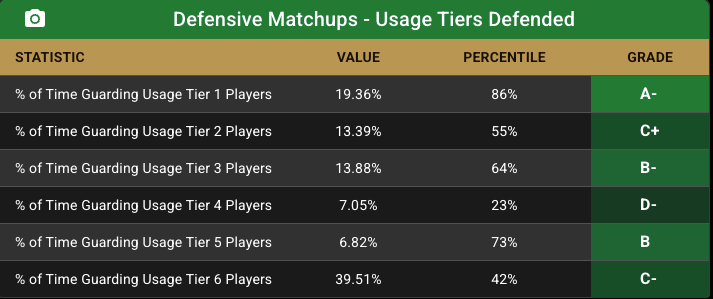
Against the Thunder, Scheierman came in at slightly under 10% of his defensive minutes being against SGA, but the fact that he was the second most trusted member of Boston’s roster to guard the MVP candidate says a lot.
In 1:58 of matchup time, SGA went 1-of-1 against Scheierman; however, the turnover that Boston’s small-town sophomore forced told the story of how disruptive he’s becoming as a defender.
Tight game. SGA on the ball. Scheierman takes the task of locking him down. Forces a turnover to give the Celtics a chance to create some separation.
We’ve seen him do this to multiple elite talents this season. He’s really becoming an unsung hero for the second unit.
4. Paint Touch Passing
The Celtics ended last night’s game with 23 assists. 10 of them came via paint touches — albeit with one being a tip-out rebound from Brown.
Mazzulla’s team is at its best when it’s getting into the teeth of the defense and carving open passing lanes. It also plays a role in opening up more opportunities on the perimeter, as opposing teams have to keep deciding whether to sag off, push up, or look to contain at the level.
I was a huge fan of this play.
Not only because it ended up with an easy, wide-open three for Hauser, but also because the more growth we can see from Neemy as a passer, the better it is for the team.
The setup for this action was simple. High PnR between Tatum and Neemy. Tatum drags out his dribble, Neemy rolls toward the rim. Tatum draws two defenders via the PnR, and then adds another to his gravity courtesy of Pritchard’s rip-screen.
Queta’s roll has forced Hauser’s man to rotate over into the paint. So, when Tatum fires the pass to Neemy, a simple re-direct finds Hauser wide open in the weakside corner.
Great offense.
Attack the initial action, force the defense to react, and then find the opening from there.
Here’s another example. Brown gets into the teeth of the defense. Pritchard mirrors his cut, lifting onto the wing to give Brown a clear passing angle for a release valve.
Pritchard then attacks off the catch (stampede cut) to get downhill before trusting himself to stay balanced on the fadeaway.
Both of these actions show the value of getting into the paint before making a read. The Thunder’s top-ranked defense was compromised on both of these occasions. And, if you go back and watch the other eight paint-touch assists — and the paint touches that ended up in missed attempts — you will see that Boston continually forced Oklahoma into some hellish situations.
Drive the rock. Good things will happen.
5. Keeping Pace With The Knicks
Beating the Thunder is great. They’re the reigning champions. They could be the team that stands in Boston’s way later this year, in a potential NBA Finals matchup — assuming everything goes to plan.
However, there was a subplot playing out during this game, and that was keeping pace with a New York Knicks team that has been rampant recently. If the Celtics had lost last night, the Knicks, who are on a 7-game win streak, would have jumped back into the second seed.
Only half a game separates the two franchises in the standings.
Now I’m not sure how much the Celtics are valuing seeding this year. I'm also not sure if Boston would prefer a potential first-round matchup against the Toronto Raptors, rather than the one against either the Philadelphia 76ers or Miami Heat that could wait if the current standings hold true.
What I do know is that finishing above the Knicks would feel good. Maybe not for the team, but certainly for the fanbase.
The Knicks were arguably the favorite to come out of the East heading into this season. Maybe they still are. So, any little advantage, be it home court, a slight mental edge, or just bragging rights for the fanbase, is welcomed.
New York has begun to peak at the perfect time. They look like a juggernaut right now.
So, beating the Thunder gave us two key victories last night. But both the Celtics and Knicks will be treading water until they meet for the final regular-season game on April 9.
love this thank u