
What Does Mitchell Robinson Bring To The Celtics?
A dive into what we can expect from Mitchell Robinson.

We came into the summer knowing the Celtics had a gap at center. Neemias Queta enjoyed a strong season in the starting lineup, proving himself as a genuinely capable starting big in the NBA. However, his struggles in the postseason meant that a potential upgrade this summer was always a possibility.
Earlier today, Brad Stevens moved to secure one of the best bigs on the free-agent market in Mitchell Robinson, who is fresh off helping the New York Knicks win the 2026 NBA Championship.
Boston used the full non-taxpayer mid-level exception to get the deal over the line. They will now be hard capped at the first apron for the upcoming season.
So, the question now becomes, what will Robinson bring to the Celtics rotation?
Let’s dive in.
Rebounding
Robinson finished the 2025-26 regular season ranked fifth in the NBA for offensive boards per game. He pulled down an average of 4.2 per game, along with a further 4.6 per night on the defensive glass.
According to Cleaning The Glass, Robinson snagged 21.2% of the Knicks’ missed shots while he was on the floor, placing him in the 100th percentile among bigs in the NBA — that number excludes garbage time.


He also averaged 1.6 putback attempts per game, converting on 52.4% of those attempts.
Joe Mazzulla will love the activity Robinson brings on the offensive glass. He will help maximize possessions.
He will come up with clutch, momentum-swinging boards that help the Celtics either crack a cold streak or pile the pressure on during a run.
A key aspect of Robinson’s offensive rebounding is that while he doesn’t rack up a ton of assists, the ones he does register are usually him finding a shooter after extending a possession.
Dimes like this are commonplace for the towering big man. He will easily command his space, snatch the rock out of the sky, and find the open shooter or cutter. Boston’s perimeter-based options will thrive on the additional looks they’re going to get — just as they have whenever Payton Pritchard comes up with a sneaky, but often clutch, board.
The same can be said for Robinson’s work on the defensive glass. He’s got no problem initiating pitch-ahead passes in search of triggering the break, or simply getting the rock out of his hands at speed.
Couple Robinson with Jayson Tatum, Luka Garza and Neemias Queta and the Celtics shouldn’t have any concerns about controlling the glass next season — on either end of the floor. Oh, and remember, controlling the glass makes it easier to dictate the game's tempo.
Screening
This is an area that concerns me. Under Mazzulla, the Celtics have found great value in utilizing their non-shooting bigs on the perimeter. Luke Kornet and Queta both found their footing with similar roles.
The approach is simple: screen, screen some more, initiate hand-offs, and roll hard. Oh, and did I mention screening again?
So, forgive me for directing your eyes to the image below, taken from the venerable Basketball Index.
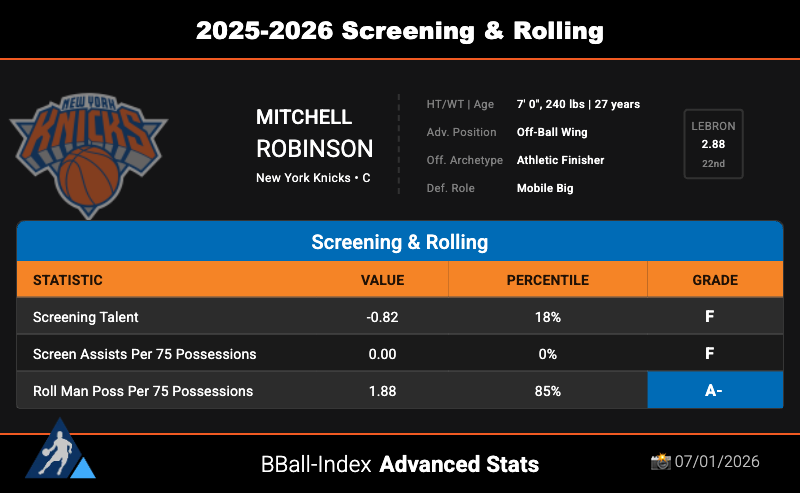
I’m not worried about Robinson’s value as a roller. His size and physicality will ensure he brings vertical spacing to the equation. My bigger concern is his lack of screening ability and the limited number of screen assists he generated last season.
Now, to be fair, New York plays a different system than the Celtics. Robinson spent far more time darting into the paint or occupying the dunker spot than he did flowing into secondary screens or running Varajao actions (flipping the angle of a screen).
So, while the data is pointing us one way, we have to be conscious that the role also has an impact.
Unfortunately, the film - or the film that I’ve watched over the past few hours - has shown that Robinson’s idea of screening is essentially giving someone a quick tap before rolling to the rack.
In one sense, I can see the value. The quicker Robinson gets into the paint, the quicker the defense collapses, and therefore, the easier it is for the ball-handler to make a read. On the other hand, this isn’t how the Celtics look to lean on their bigs.
Boston will want space creation on its screens. It will want movement on the perimeter to unlock scoring threats and open up space between defenders and shooters. These half-hearted high fives won’t fly. Not with the system we saw last season.
Not under Mazzulla.
Here’s another example of Robinson’s questionable screening. This time, he makes full contact with Jalen Brunson’s defender; however, limited separation is created. Part of the issue appears to come from the angle Robinson takes when setting his screen. If he could open up his hips a little and leave less room for the defender to fight through, there could be some serious advantage creation at play.
The Celtics coaching staff had enjoyed success in developing bigs in recent years. If they can improve Robinson’s screening, it will elevate his overall impact under Mazzulla.
Still, work will need to be done.
Scoring
If there’s one thing we can be sure of, it’s that Robinson’s shot profile is as one-dimensional as it gets — in a good way. He knows who he is as a player, and he makes the most of his size and talent.
Here’s a screenshot of Robinson’s shot frequency by location throughout his career.
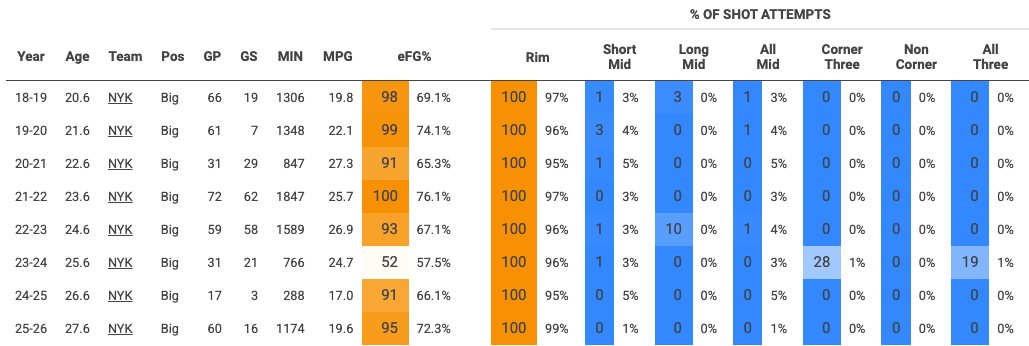
What doesn’t come around the rim primarily comes via push shots, baby hooks and floaters. It’s an old-school big-man's shot diet and one that should pay dividends for the Celtics, considering that Robinson will likely be expected to find his scoring chances via offensive boards, putbacks, lobs or dump-offs.
Last season, Robinson attempted 206 two-point attempts. As we can see, they almost exclusively came at the rim. Of those 206 attempts, 122 came via putbacks, with him shooting 58% on those specific shots, per Synergy.
Let’s put that into perspective…59.2% of Robinson’s shots last season came via second-chance attempts. What’s more, the hulking big man drew shooting fouls on 11.5% of his putbacks — an easy 14 trips to the free-throw line.
Unfortunately, what Robinson gives in second-chance scoring and interior dominance, he takes away as a free-throw shooter. There’s a reason Joe Mazzulla has previously deployed the hack-a-Mitch strategy, and why teams feel comfortable fouling him when he’s looking to get the ball back up.
Robinson attempted 103 free throws during the 25-26 regular season. He made 42 of them. Now, 40.8% shooting is fantastic for someone making a living behind the three-point line. However, it’s downright disgusting for someone at the charity stripe.
We’ll need to live with the brutality that is a Mitch Robinson free throw. It’s not going to change, and he gives you enough around the rim — especially on the offensive glass — that you’ve gotta be willing to turn somewhat of a blind eye.
Still, if Robinson can create extra offensive possessions and score at a (roughly) 70-75% clip, his offensive production will be both noticeable and important to how Mazzulla will likely look to construct the Celtics’ offense next season.
Defense
From the moment the Celtics were eliminated from the playoffs, I was harping on about the need to get a defensively versatile big. Someone who can switch, hedge, play up-to-touch, operate as a true cog in a switch-everything system.
Robinson is not that guy.
And that’s ok.
Assuming the Celtics lean into a system that sees 1-through-4 switch, pinch, and funnel, the trio of Robinson, Neemias Queta and Luka Garza are all capable of being rim deterrents.
Last season, Robinson ranked in the 87th percentile among bigs for blocks, swatting away 3.1% of opposing teams’ shots. That worked out to 1.2 blocks per game, with a total of 70 seats for the season.
Not only will Robinson block shots, but his presence in the paint will deter drives, force shooters into tougher decisions, and offer a genuine post defender if teams opt to try and work out of the block (not like that happens much these days).
Furthermore, Robinson is better-than-expected when guarding screening actions around the high help-line or at the free-throw line extended.
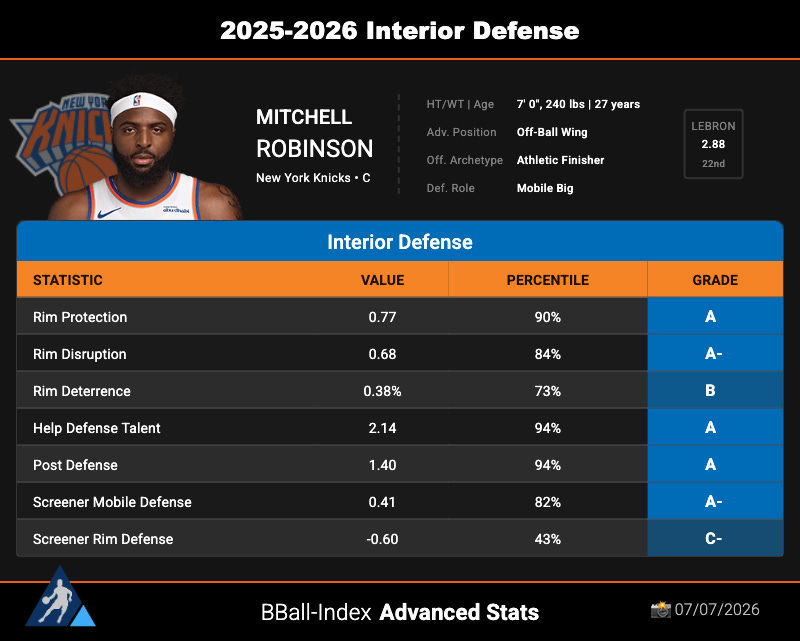
However, like Queta and to a slightly lesser extent, Garza, Robinson is out of his comfort zone when being pulled out onto the perimeter. Mazzulla must find a way to ensure his three bigs can operate in their drop defensive coverage without being manipulated to guard up at the three-point line.
There’s no point having a trio of rim deterrents and gatekeepers if you’re going to ask them to try and survive so far away from the hole.
If the Celtics do find themselves in need of a switchable big who can provide energy as a switchable five, Chris Cenac Jr. projects to be that guy. Maybe not this season, but for spurts? Sure.
Overall, though, Boston is betting on drop defense and rim deterrence/protection from its big man committee. As long as the team remains disciplined — especially with nail help — they should be a tough team to score on across all three levels.
Health
Here’s where I understand a lot of people’s concerns.
Similar to another rumored Celtics target this summer — former draft pick Robert Williams — Robinson has struggled with injuries throughout his career.
While those injuries haven’t been a recurring theme, they have certainly piled up over the years. Shortly after Boston’s acquisition of Robinson, I spoke with Jonathan Macri Knicks Film School for a podcast episode, diving into what the Celtics were getting in their latest big man and how Knicks fans have felt about him over the years.
You can check out the audio here:
Or the Video here:
Anyway, Robinson’s health inevitably came up during the conversation, and the key takeaway was that Boston will likely need to continue with the Knicks' minute-management plan for Robinson moving forward.
“There was never a specific minutes limit, so to speak,” Macri said. “I think there were some games this year where he played in the high 20s, over 25. (But) You can probably count them on one hand…They basically treated him like a sub-20-minute-a-game player in the league…So your starting line is not 82 games, assuming the Celtics also continue with the plan, and they may not.
If they don't, that would actually worry me more as a Celtics fan if the Celtics were like, "You know what? We're gonna run Mitchell Robinson out there on the second night back-to-backs. We're gonna be fine with it." If they continue treating him with kid gloves, your ceiling is probably 20 to 25 minutes per night over 65 games, and that's not even factoring in other injuries.”
The Celtics are no stranger to getting the best out of talents who need their minutes managed. We’re not that far removed from Malcolm Brogdon’s Sixth Man of the Year-winning season, where he was handled with kid gloves throughout the season.
There’s also the caveat that Mazzulla has solid depth at the five spot now. Queta, Robinson and Garza are a solid, reliable, and somewhat proven trio. Factor in Amari Williams on a two-way and Chris Cenac, who can offer something different, and there’s every reason to think Boston can make things work.
Still, if you’re concerned that Boston added a big who will need managing, and hard-capped themselves while doing so, I understand. However, from my standpoint, they’ve landed one of the best offensive rebounders in the NBA, who just so happens to elevate them on both sides of the floor.
Nothing in life is perfect, so as long as the good can potentially outweigh the bad, you have to roll the dice — and with Robinson, who rebounds, deters and finishes, the Celtics just got better.