
The Night Nothing Dropped
The Celtics went ice cold from the field in the second half.

*First things first, happy birthday to my daughter, who turns 15 today! I have no idea where the time went, or how I’m still years away from being 40 with a teenager one year out of leaving high school (you leave at 16 in the UK). Still, here we are.*
So, last night happened, huh?
The win streak snapped, just like that.
I blame the break.
The Boston Celtics were riding a wave of momentum through their last 10 games. And, in the first half of the loss to the Milwaukee Bucks, that momentum was still operating as the wind at their backs.
Then, a 13-point third quarter happened.
13 points.
What. A. Disaster.
After shooting 11-of-23 from the three-point line over the first two quarters, the Celtics went 3-of-26 in the second half.
Even their two-point efforts stop falling, going 9-of-20.
The offensive approach didn’t change. Boston still ran its Zoom actions, Spain actions, chest actions, came off ghost and flare screens, and they still looked to make the extra pass when guys were wide open.
We’re not talking about an offensive execution from a game plan standpoint.
Nope.
We’re talking about an offensive execution from a shot-making standpoint. Sometimes, the ball just doesn’t want to drop. Cliche, I know, but that doesn’t make it any less true…
With that in mind, I want to look at two plays that drive home the idea that, at least in terms of offense, the Celtics had great process in generating quality shots, and that it was the inability to convert those looks that cost them.
This clip is a good example as any.
Milwaukee’s defense was cooked by the time Hauser found himself with a catch-and-shoot opportunity. No defender within 6 feet (wide open). All the time in the world.
Clank.
Let’s look at this play a little deeper.
The play starts in transition. Payton Pritchard is pushing the tempo and pitches the rock ahead to Sam Hauser.
As you can see in the still below, Jordan Walsh is calling for the pass as he looks to cut middle, pressuring the paint and the rim. However, the Bucks have built out to the ball. Cole Anthony is zoning up the weakside corner (Anfernee Simons) and the paint.
If Hauser hits Walsh with the pass, he has to finish through or around Anthony. Instead, Hauser opts to swing the rock over to Simons, knowing the inferno-style scorer can beat his man off the closeout or knock the shot down off the catch.
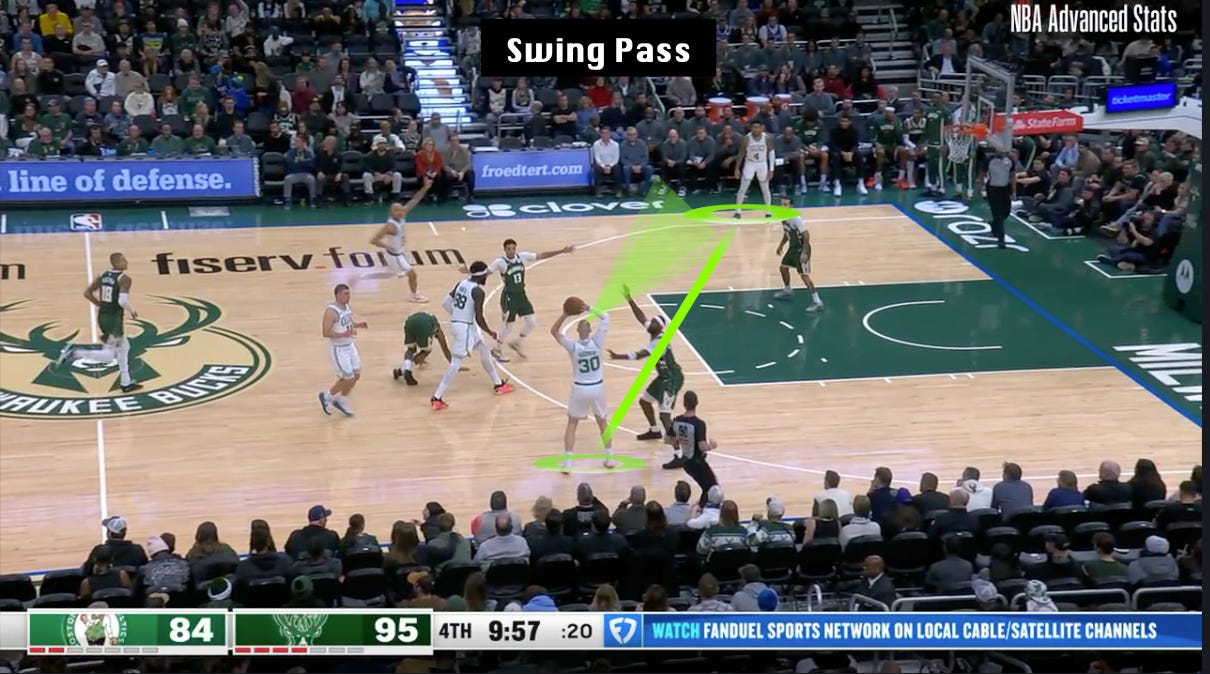
By the time the ball reaches Simons, Cole has rotated over, planting his weight, thus making it difficult for him to change direction on a dime. Simons counters the close-out with a drive, giving himself a step or half a step advantage.
However, Kyle Kuzma has read the action unfolding and turned the jets on, beating Simons to his spot.
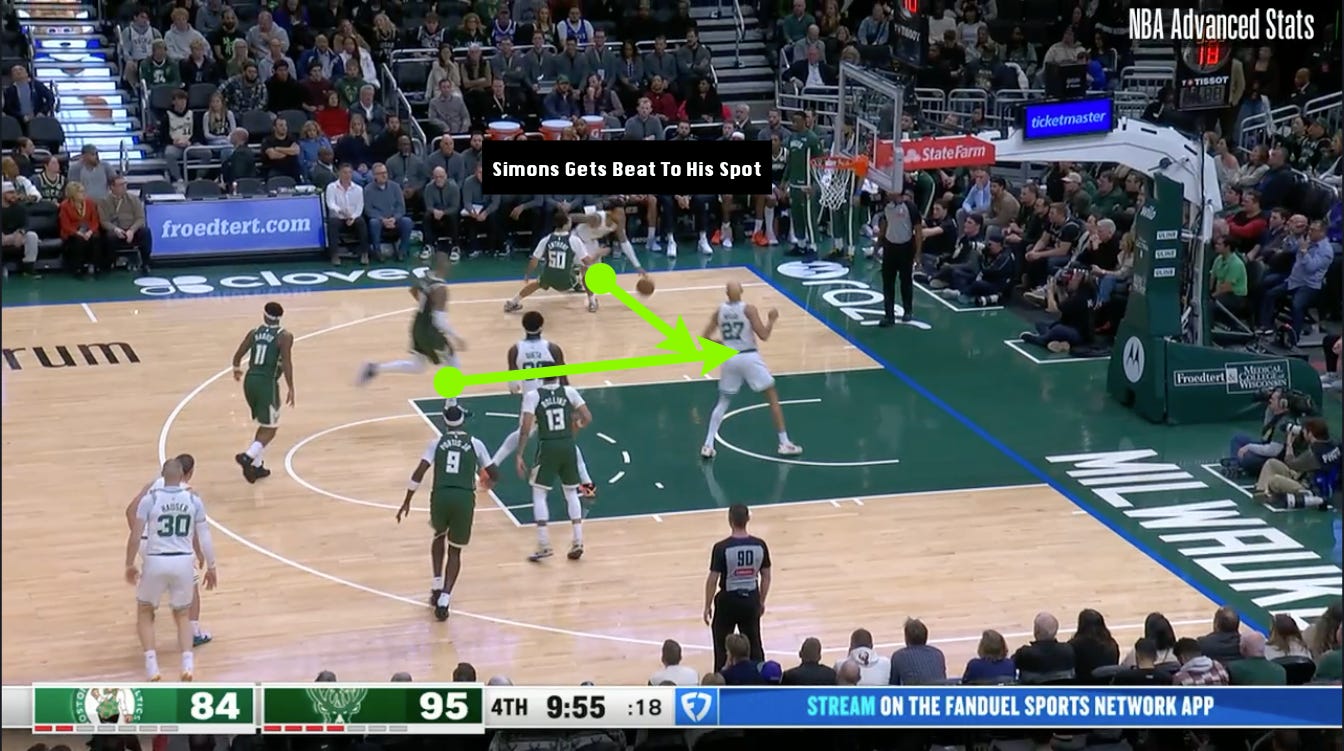
With the paint walled off, thus taking away the baseline drive into a rim finish, and a defender on either side with another coming towards him, Simons has to get the rock out of his hands.
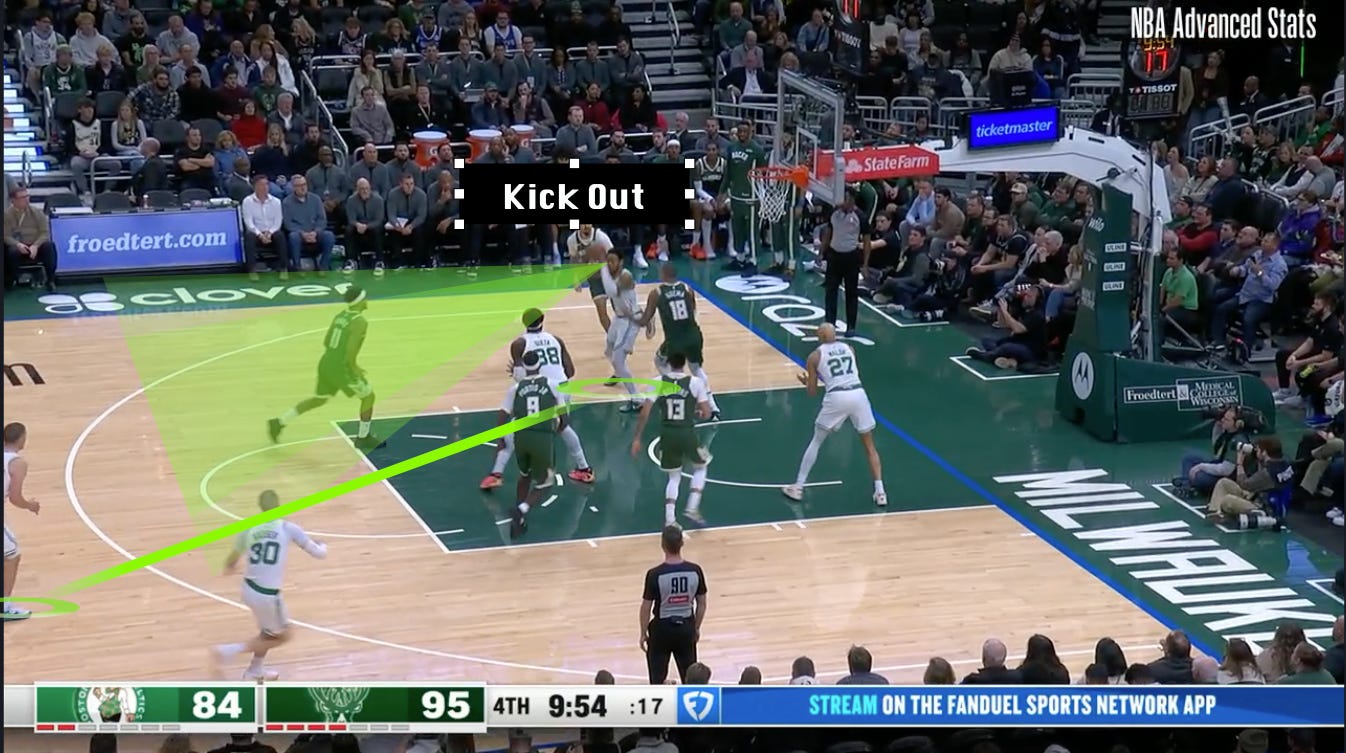
Both Pritchard and Hauser have been left alone on the perimeter. Simons has a clear line of sight to Pritchard, making him the easiest outlet pass.
Side note: When looking at the below still, it’s easy to see Walsh in the dunker. For Simons, though, that’s a hard pass to see — and an ever harder one to pull off.
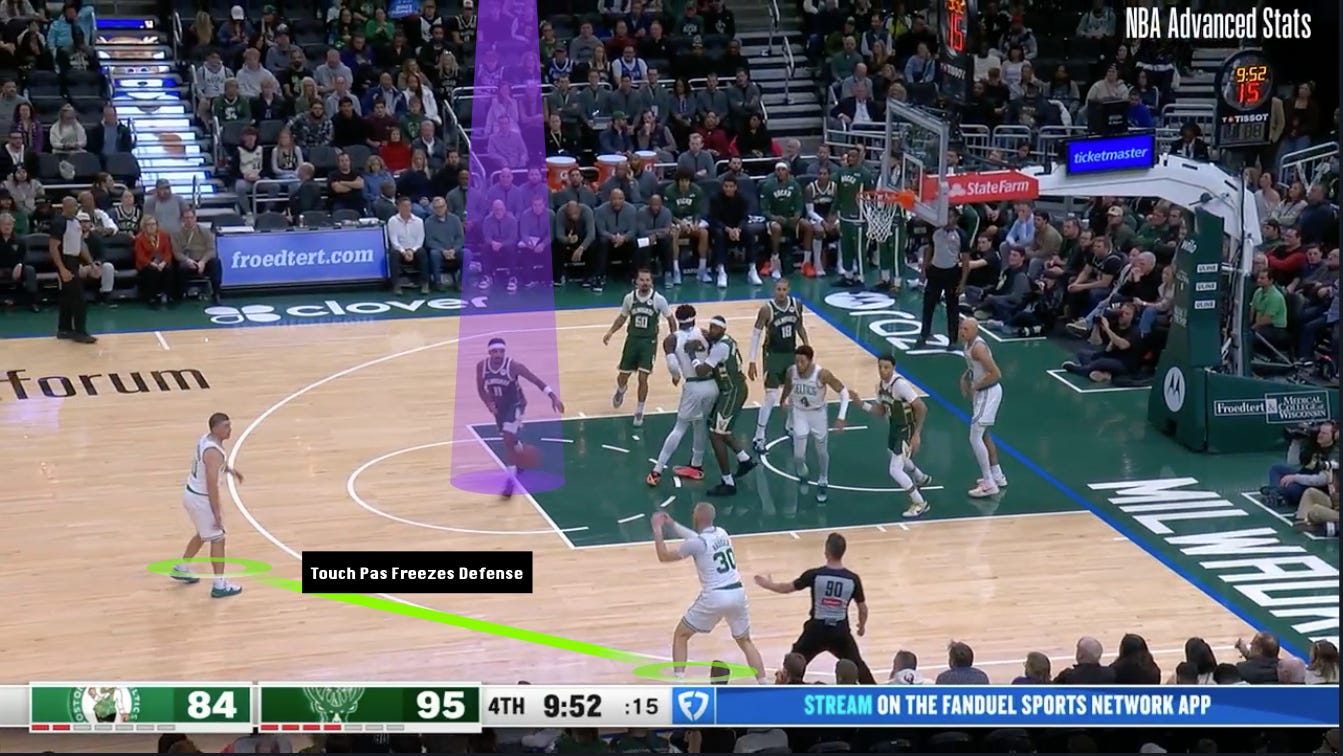
As soon as Simons makes the kick-out, Gary Harris looks to recover out to the ball. Pritchard makes a touch pass to Hauser, killing Harris’s close-out and freezing the defense.
At this point, Milwaukee can rush out to Hauser and potentially open themselves up for another drive and kick — or even an entry pass to someone in the dunker — or, they can live with the results.
They chose the latter.
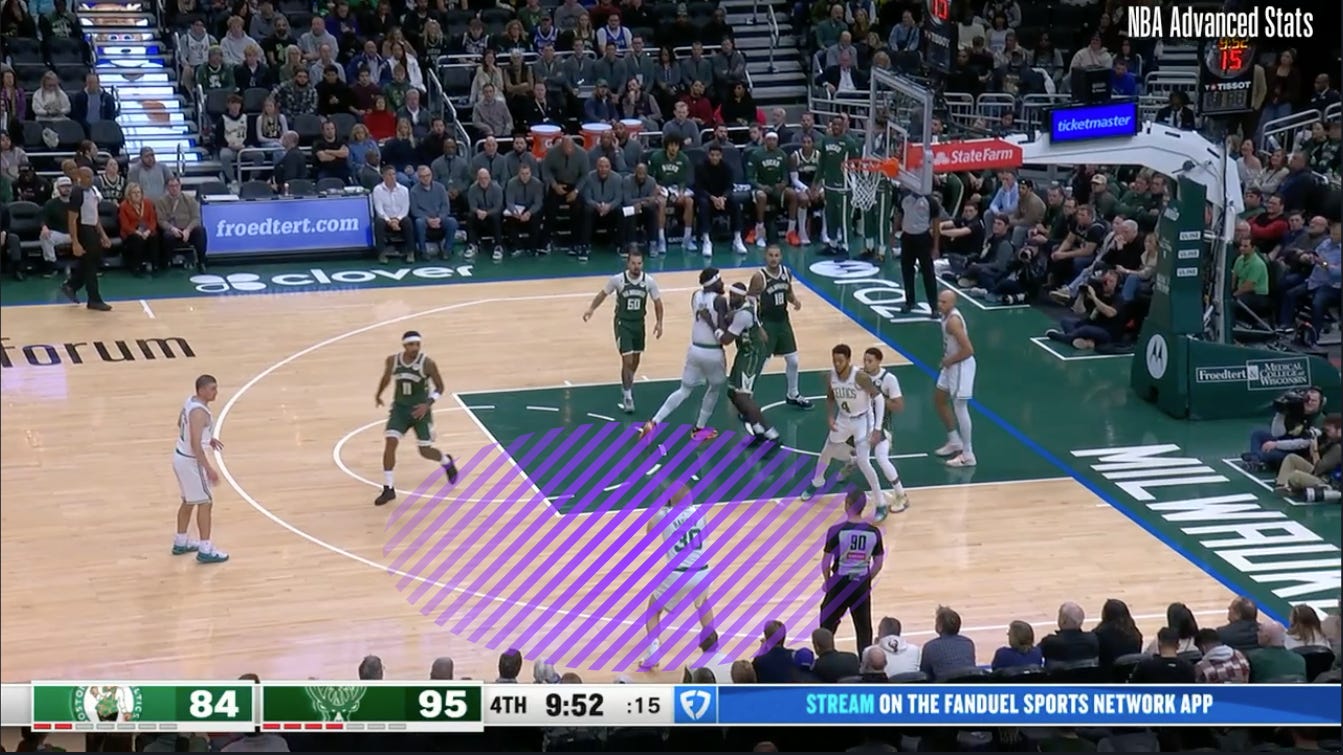
Just look how much space Hauser has between him and the nearest defender.
Easy money, right?
This was just one of Hauser’s ten misses.
Woof.
Here’s another…
Keep reading with a 7-day free trial
Subscribe to The Celtics Chronicle to keep reading this post and get 7 days of free access to the full post archives.