

How many times have we asked this question since Joe Mazzulla took over as head coach?
This is the fifth straight season the Celtics’ three-point frequency has been a topic of contention. We’ve seen Mazzulla-coached teams play 346 regular-season NBA games so far, and they’ve won 72.3% of those outings. We’ve also seen a similar approach over 57 playoff games, with a 63.2% win rate and a championship as proof of concept.
However, whenever the Celtics go through a rough patch, the volume of threes becomes a focus.
I’ll be the first to admit that I prefer a more balanced offense. I’m also the first to admit that it’s the quality of the shot that matters most. If the offense has moved well, swung the ball, created advantages and then made the most of them, you have to live or die by the result of those shots.
Nevertheless, as we move past a four-game losing streak that included stinkers against the Sacramento Kings and Golden State Warriors, Boston’s three-point volume remains a simmering issue for some.
So, today, I wanted to look at the numbers.
To begin with, I thought the best place to start was to compare last season's three-point volume with this season's.
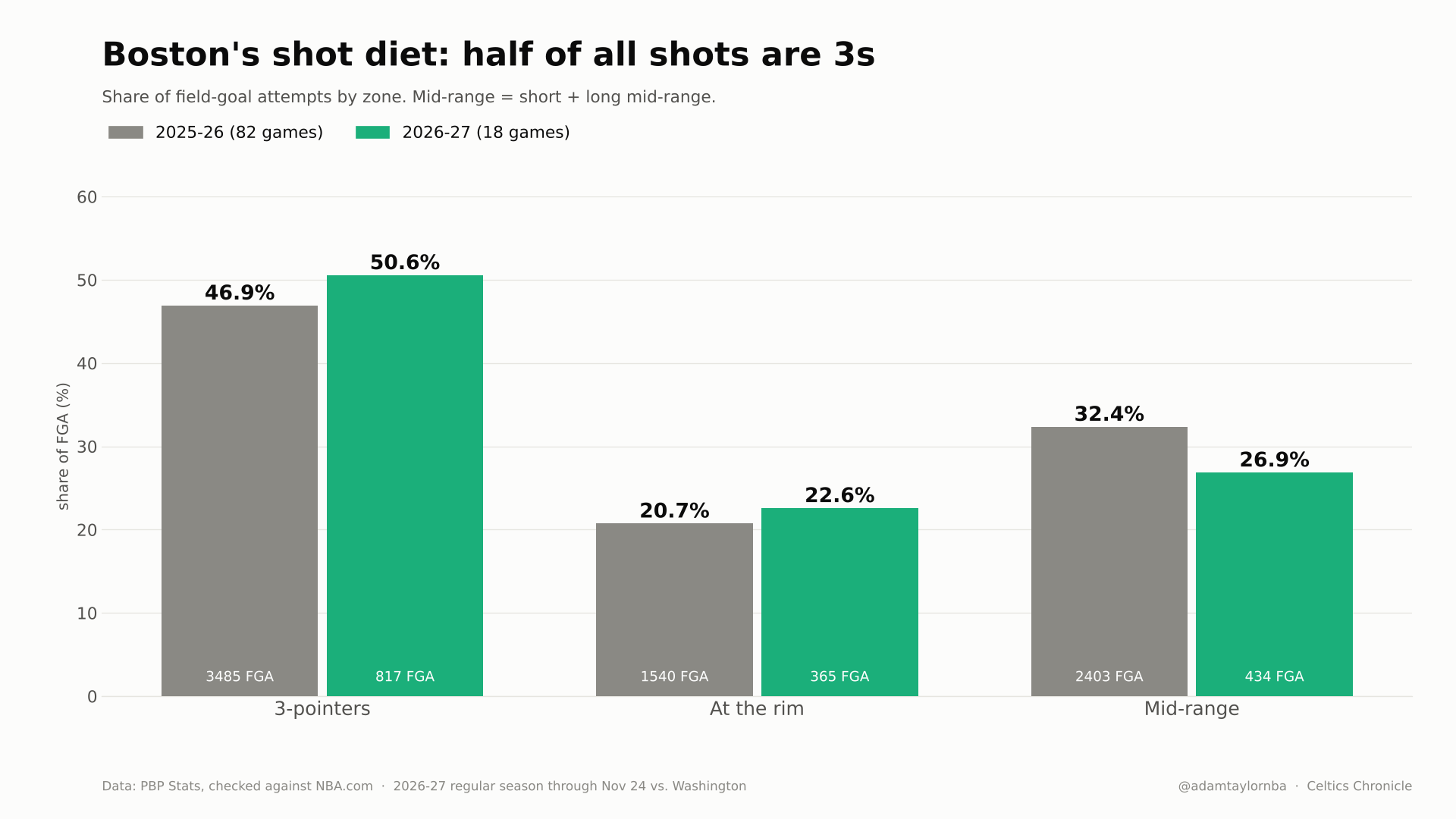
When Jaylen Brown was traded, it felt inevitable that Boston would swap out some of its mid-range offense for more looks from deep, and potentially at the rim. Looking at last season's shot-location data vs. what we’ve seen so far this season (via PBP Stats), that’s exactly how things have played out.
In fairness, the drop-off hasn’t been as steep as I imagined, but it’s been enough to bump up shot attempts elsewhere.
We’ve seen a 3.7-percentage-point rise in the Celtics’ three-point shot frequency and a 1.9-percentage-point rise in attempts at the rim. Those numbers might look small, but the Celtics are taking roughly three more threes per night than they were last season.
Over 82 games, that's an extra 240 bites of the apple from the perimeter and about 120 more looks at the rim. All those shots have come from the mid-range part of Boston’s shot diet, swapping one of the least efficient jumpers for two of the highest-value looks in basketball.
The math checks out.
Yet to make the most of this approach, the Celtics need to maximize those shot attempts. Right now, that’s where the problem appears to lie.