
The Trade That Ended "The Jays" Era
The reasoning (kind of) makes sense. The landing spot doesn't.

Well, that happened.
After weeks that felt like months, the Jaylen Brown saga has come to an abrupt end. The Boston Celtics move on from the “Jays” era and will now begin to retool the roster around Jayson Tatum and his vast array of skills.
That’s what we should be telling ourselves right now.
Instead, we’re left scratching our heads, wondering what exactly happened and what it means for the future.
None of us has any answers right now.
The only thing that feels remotely certain is that Brad Stevens, fresh off his second Executive of the Year award, now has the lowest approval rating among the Celtics fanbase at any time during his tenure with the franchise, both as a coach and member of the front office.
Let’s refresh our memory on the trade that shook us all to the core last night.
Boston Gets: Paul George, a 2028 first-round pick with the chance it converts into a more favorable pick swap, a 2031 unprotected first-round pick, a 2028 second-round pick (most favorable of GSW/OKC/MIL) and a 2030 second-round pick (most favorable WAS/PORT/PHX).
Sixers Get: Jaylen Brown
I remember seeing this trade, literally seconds after Tim Sheils and I had finished recording a podcast, and thinking, “They must have really wanted to move on from Jaylen. Is this what they settled for?”
That thought process stayed with me through the night. However, when I awoke this morning, I read two stellar pieces of work. The first came from the venerable Adam Himmelsbach of The Boston Globe, with the following piece of reporting giving me reason to pause.
“One league source said Boston’s brass agonized for days over the decision to trade Brown but eventually determined that acquiring valuable assets along with a nine-time All-Star in George offered the franchise its best path forward,” Himmelsbach wrote.
The second piece came from the equally talented Tom Haberstroh, who gave a fair and well-reasoned take on why the Celtics may have felt comfortable calling time on Jaylen’s tenure with the Celtics.
“The debate shouldn’t be whether Brown is the seventh-best player on a team,” Haberstroh wrote. “The real discussion is whether he’s the seventh-best player in the league — because he’s being paid like that. The Celtics had to decide whether he was worth taking up that much of the cap.”
What I took from these two pieces was that Boston had decided it was time to move on from Brown, and the wider data surrounding Brown’s impact on the Celtics point to the fact that it was potentially the right call.
Fine, I can deal with that. If the decision was made with team success in mind, and the data was unequivocally pointing you in a certain direction, then do what you’ve got to do.
But, like, did you really need to send Brown to the Philadelphia 76ers of all teams? The team that just beat you in the postseason. The team that now has Tyrese Maxey, VJ Edgecombe, Jaylen Brown and Joel Embiid?
That, to me, is the hardest sell of the entire situation.
Was Portland genuinely off the table? Even with a stable of guards that ultimately will need balancing out, and an abundance of draft picks?
What about the other list of teams you were reportedly talking to? Was Brown’s value that low around the NBA that what you got from Philly was the best you were going to get?
Maybe it was.
In the modern NBA, with the way the new CBA is set up, the cost-to-impact ratio has to be a driving factor. Brown came at a high cost. However, his impact, per the numbers, didn’t match his pay.
According to Dunksandthrees.com, Brown has never sniffed an elite-level Estimated Plus-Minus (my favorite stat for measuring on-court impact relative to the players he shared the floor with and went up against).

To put this into perspective, I rank an All-Star talent as having an EPM of +2.0 to +3.9. They’re solid, above-average talents who can thrive as a secondary option on an elite team.
Interestingly, this is where some of the disconnect between the fanbase and the analytics stems from. Brown was an All-Star this season. He finished sixth in MVP voting. Yet, according to one of the most stable impact metrics (in my opinion), he performed like the 77th most impactful player in the league.
We can all agree that Brown is FAR from a top-80 guy. I have him in the 15-20 range. Yet, that disconnect, between what the numbers measure and what our eyes see, is rarely so far apart. Usually, the most impactful guys are also the best players. It’s such a weird dichotomy.
Usually, a player who finds themselves in the MVP conversation would be posting an EPM of +4.0 or more. That’s an elite range. Genuine superstar territory.
Brown has never come close to reaching those heights. Not even this season, when he was the clear-cut first option and led the team to the second seed in the Eastern Conference.
George, however, has spent large stretches of his career in that upper echelon of NBA talent - regularly posting above a +4.0 during his prime.
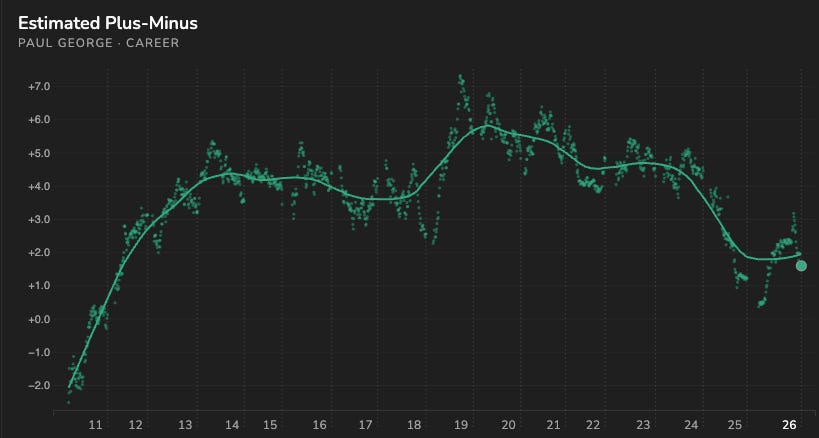
Now, don’t get me wrong, I do not think that George, in this stage of his career, is a better player than Brown. I’m not delusional, and the green goggles haven’t slipped over my eyes.
Even this past season, George posted a higher EPM than Brown (+1.6 vs. +1.5). The fact that EPM already adjusts for the caliber of teammates and opponents each player faced is what makes this comparison fair. Despite a smaller role, George was still just as impactful, if not slightly more, than Brown.

That’s the impact part covered.
Now we look at the cost.
Brown has three more years remaining on his $285 million supermax contract. He’s going to earn $57 million this season. He’s also eligible for a two-year $141.9 million extension later this summer.
For a moment, let’s assume the Celtics opted to extend Brown. That would have put them on the hook for an approximate total of $324.9 million over the next five years.
Over a quarter of a billion dollars.
Then re-factor the impact — Brown would have been earning superstar money with (what the metrics say is) an All-Star-level production. That’s like leasing a Lamborghini but having a BMW delivered, with no way to return it to get what you’re actually paying for.
Even granting the metrics aren't perfect, Brown’s production isn’t at the level to command such a hefty cap hit. Because, outside of the eye-watering figures, that’s what this is all about. Having Tatum and Brown eat up more than 70% of the cap, when only one of the two is making a superstar-level impact, is a hard sell, especially under the new CBA and the limitations surrounding team building.
We haven’t even factored in the data that says Boston plays better with Brown off the floor, and has done so consistently, I might add, for multiple years.
“The truth is that in the last four seasons, the Brown-less Celtics went a sizzling 47-10 (.825), which is the equivalent of being a 68-win team, enough to earn the No. 1 seed in almost every season on record,” Haberstroh shared. “That's not analytics. That's just counting wins and losses for a team without a certain player.”
Then we turn our eyes over to George, again.
Two years remaining, with the final year a player option that I assume he picks up. A total of $110.7 (ish) million committed. Similar impact metrics to Brown, shorter contract, and potentially tradable both this season and especially next, because we all know expiring deals are oftentimes easier to move.
Boston has shortened its financial commitment by multiple years, while keeping a similar level of impact. The only true concern the franchise will likely have is that George has proven incapable of seeing out a full season in recent years.
Not only does George struggle to stay healthy, but he also misses lengthy stretches at a time. Nevertheless, if Stevens feels he will have an easier time moving on from George, either this season or next, then so be it. After all, if the Celtics can stay out of the tax this year, the repeater will be cleansed, and Boston can start spending again next summer, and that is key to everything we hope the Celtics are planning.
Of course, there is another aspect to this trade: the draft picks.
Boston now has a fistful of first-round picks in the coming years, including a couple of more favorable swaps. They have even more second-rounders — the full list can be found here.
The Celtics have the assets necessary to make a swing at another talent — be that this summer for someone like Trey Murphy, or in the future when another disgruntled star inevitably emerges on the market.
Of course, should the Celtics struggle for whatever reason, they’ve got a higher chance of securing a lottery pick, which in turn, adds another cost-controlled asset to their growing treasure chest.
Optionality.
That’s going to be the buzzword over the next 12-to-18 months. The Celtics have options now. George’s contract isn’t a debilitating over the mid-term. The picks provide additional room to operate at negotiating tables. And, most importantly, the Celtics still have a top-5 talent to build around as they continue reshaping the roster.
Last night, we all went to bed with a sense of sadness, frustration and confusion.
Nothing made sense.
It was raw.
We were pissed.
Now, just one sleep later, the trade still hurts. Yet, after having some time to begin comprehending the reasons behind why Boston may have decided to take this route, there’s a little bit of clarity.
So yeah, that happened.
At least now, we have some inkling of why, even if we hate it.
I don't hate the trade. I was just hoping Boston would get a war chest of draft picks in return-similar to what OKC got from the Clippers for Paul George. But, I'm sure the advanced numbers on Jaylen contributed to that not happening.
Another great analysis Adam, just find it hard to believe that this was the best offer Stevens could get. I knew they could not keep and extend Brown and Tatum at their age but thought Denver Charlotte Portland NOLA, Spurs could offer more. Did Portland choose Ja at $40M+ over Brown? Hoping he can find a team that's close that need that Paul George vet presence that is willing to make a move for younger talent but that a big salary. As we have seen with Holiday and others maybe White soon, if brad feels he isn't getting the value for the contract, he will move it. Hoping we can get Kuminga Murphy or Cam Johnson or other value with the exception and for White Hauser Pritchard. Would try Pritchard back home for Scoot Henderson. It does appear we will get the Clippers first in 2028 if between 1-16